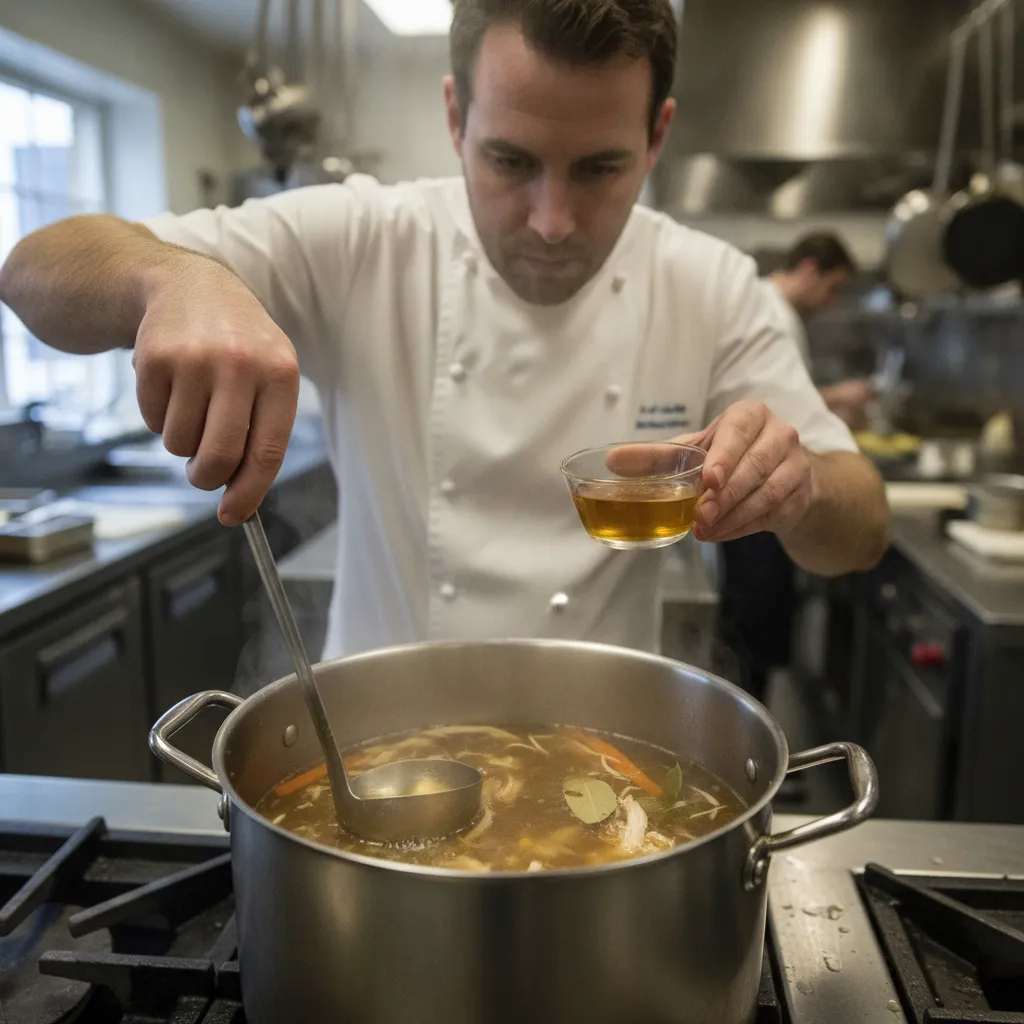
For many home cooks, achieving a professional grade chicken stock often feels like a gamble between a rich gold liquid and a murky, opaque mess. According to several industry experts, including Adam Byatt of London’s Trinity restaurant, the culprit behind cloudy stock is almost always impatience. When the heat is too high or the liquid boils vigorously, fats and impurities emulsify back into the base rather than staying separated, resulting in that dreaded haze. To avoid this, chefs insist on a low and slow approach using a heavy pot that allows ingredients plenty of room to move without excessive agitation.
Techniques vary among professionals but generally center on temperature control and meticulous cleaning. Alissa Timoshkina suggests starting with cold water and bringing it to a boil very slowly before dropping to a gentle simmer. For those whose stock still looks slightly clouded, she recommends straining it through a fine sieve and adding a splash of lemon juice to brighten both the color and the flavor. Meanwhile, Lloyd Morse from Edinburgh’s The Palmerston emphasizes the importance of aggressive skimming, advising cooks to remove every bit of scum that rises to the surface early in the process.
Some chefs prefer even more extreme measures for absolute purity. Louis Lingwood of Osteria Vibrato advocates for cooking his stock on the lowest possible setting for an entire day, followed by a cooling period where fat can rise naturally to be ladled off. His ultimate secret involves utilizing the freezer; defrosting stock through muslin cloth acts as a secondary filtration system that leaves the liquid crystal clear. This method ensures that any remaining particles are trapped in the fabric during the thawing process.
For those seeking convenience without sacrificing quality, moving away from the stovetop entirely might be the answer. Chef Morse suggests transferring ingredients into an oven safe dish and letting them cook overnight at roughly 90 degrees Celsius. Because ovens provide indirect heat, they eliminate the risk of boiling over or overheating specific spots in the pot, virtually guaranteeing clarity while filling the house with an inviting aroma by morning. Whether via slow roasting or careful simmering, the golden rule remains simple: stop boiling your bones if you want transparency in your bowl.